
Ask what a septic pump-out costs and every honest answer begins the same way: it depends. That isn't a dodge — the work genuinely differs from property to property, and the difference is mostly physical. How much material has to come out, how hard it is to reach the tank, and how much of the job is removing settled sludge rather than just liquid all change how long a crew spends and what equipment they need. Once you understand those levers, quotes stop feeling arbitrary and you can describe your property in a way that gets you a firm number faster.
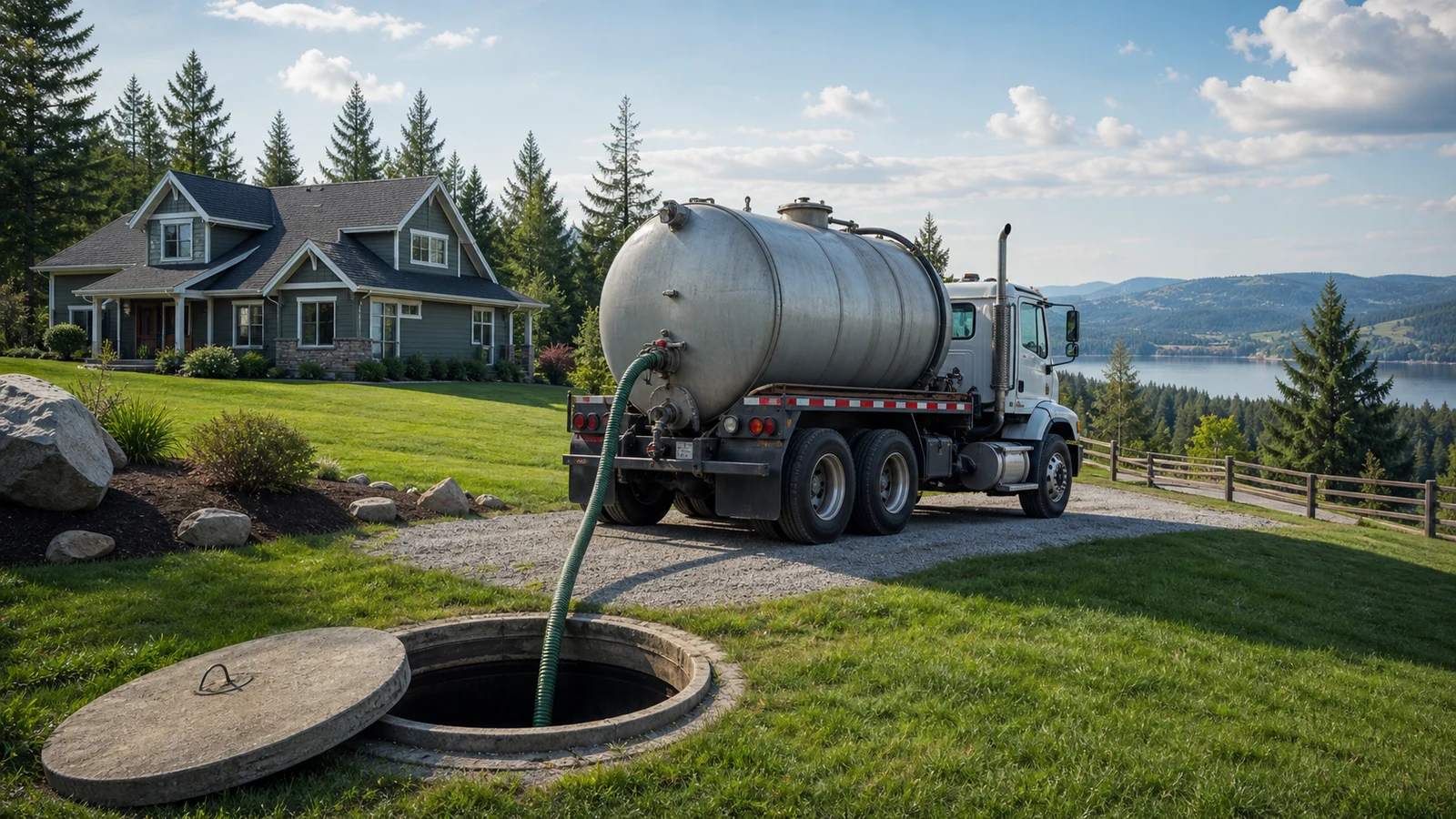
Tank Size — and How Full It Actually Is
The single most predictable factor is volume. A larger tank simply holds more, and a multi-compartment tank takes longer to service than a small single-compartment one because each compartment is handled in turn. Most homes fall into a common mid-size range, but larger households and properties with add-ons can have bigger tanks that take proportionally longer.
Just as important is how full the tank is when the truck arrives, and that comes down to time. Solids settle and slowly compact into a dense sludge blanket at the bottom. A tank serviced on a reasonable schedule holds a manageable layer that pumps out cleanly. A tank left for a decade or more holds a thick, hardened layer that has to be broken up and worked loose — more time, more effort, and often the moment a provider discovers a baffle problem or a struggling drain field that was hidden until the tank came down. This is why waiting rarely saves money.
Access — Usually the Biggest Swing
If tank size is the predictable factor, access is the variable one, and it can change a quote more than anything else. Several things fall under access:
- Lid depth. A lid at or near ground level is the easy case. A lid buried under soil, a patio, a deck, or landscaping has to be located and excavated before pumping can even begin — and that digging is labor that gets billed. Installing risers that bring the lids up to grade eliminates this on every future visit.
- Distance from the truck to the tank. Vacuum hoses have a practical working length. A tank a short walk from where the truck can park is straightforward; a tank at the far end of a long drive, downhill, or behind the house can require extra hose and setup, and in some cases a different approach.
- The route itself. Narrow gates, soft or wet ground, steep grade, and low branches all affect whether — and how easily — a heavy truck can reach the tank. This matters more on the rural and wooded lots common across the Upper Cumberland.
Whether the Tank Has to Be Found First
On many older properties, no one knows exactly where the tank is. Locating it is a real step that takes time before any pumping happens. You can avoid paying for it repeatedly: once the tank is found, measure its position from two fixed points on the house and write it down, or add risers so the lids are visible. Our guide on finding septic records and tank locations covers how providers locate a lost tank and how to keep it findable afterward.
Pumping vs. Cleaning — Confirm the Scope
"Pumping" and "cleaning" are sometimes used to mean the same thing and sometimes not. Removing the liquid is one level of service; fully agitating and removing the settled sludge from every compartment is a more thorough — and more involved — job. A tank that has been "pumped" can still hold a compacted layer if only the liquid came off. Before comparing two quotes, confirm which scope each one covers, because a cheaper number for a lighter service isn't really cheaper. Our guide on pumping versus tank cleaning explains the difference in detail.
What You Can Do to Keep the Price Down
Most of what drives a pumping bill up is avoidable over time:
- Keep the lids accessible — risers to grade remove the digging step on every future visit.
- Record the tank's exact location so no one spends billable time hunting for it.
- Clear a reachable path for the truck before the appointment — mind gates, mud, and low limbs.
- Stay on a sensible pumping interval so each visit is routine rather than a heavy dig-out.
For how to set that interval, see how often a septic tank should be pumped.
How to Get an Accurate Quote
Providers price confidently when they can picture the job. A request that mentions the tank size if you know it, whether the lids are exposed or buried, how a truck reaches the tank, and roughly when the system was last serviced will get you a much tighter estimate than "how much to pump my tank?" Exact pricing is always set by the provider after seeing the property — but with those details, the estimate conversation is short. When you're ready, request septic service with as much of that detail as you have.
This guide is general information for property owners, not professional advice for any specific system. Systems, soils and requirements vary by property and county — confirm specifics with a qualified provider or the appropriate authority. Cumberland Septic Hub is an independent referral service; provider availability, qualifications, pricing and service terms are determined by the provider.
Helpful Septic Guides
- Septic Costs and Pricing Factors — the cost topic hub
- Septic Pumping and Maintenance — routine service basics
- Septic Repairs and Drain Fields — where repair costs come from
Cumberland Septic Hub is an independent referral service. Requests may be shared with an independent local septic provider, and the provider determines availability, qualifications, pricing and service terms. Read the full referral disclosure.